

Table of Contents
- Do Odor Neutralizing Candles Really Work? The Short Answer
- Odor Neutralization vs. Masking: What's the Difference?
- How Odor-Neutralizing Ingredients Are Claimed to Work
- Are Scented Candles Safe for Pets?
- Pet Odor Eliminator Candles: What to Look For
- How to Get Rid of Pet Odors: Candles Plus Source Removal
- How Long Do Odor-Eliminating Candles Last?
- Verdict: Where Odor Neutralizing Candles Win and Where They Don't
- Frequently Asked Questions
Last Updated: October 16, 2026
Do Odor Neutralizing Candles Really Work? The Short Answer
Do odor neutralizing candles really work? Partly. They can reduce airborne odor intensity in a room, but cannot remove the source of a persistent smell.
Odor neutralization alters odor molecules in the air so the nose detects them less strongly; masking covers one smell with a stronger one.
Not every scented candle works the same way. Wax type, wick, fragrance load, and burn conditions all change the outcome.
Odor Neutralization vs. Masking: What's the Difference?
Masking hides a smell; neutralization targets the odor molecules themselves. A masking candle floods the room with fragrance until your nose notices perfume more than pet odor; a neutralizing candle reduces the odor compounds so there is less left to cover.

In practice, most scented candles do some of both, with the fragrance blend doing the heavy lifting. That is why perceived effectiveness varies so much from room to room.
Three factors decide which effect dominates:
- Fragrance strength: A heavier fragrance load tends to mask more than it neutralizes.
- Air circulation: Good airflow spreads both the fragrance and the neutralizing compounds through the room.
- Odor intensity: A faint room odor is easier to reduce than a strong, freshly deposited one.
The American Chemical Society overview of volatile organic compounds explains why odor molecules behave this way in open air.
How Odor-Neutralizing Ingredients Are Claimed to Work
Odor-neutralizing ingredients are claimed to bind with or break down volatile compounds so they are no longer detected as odor, a chemical reaction rather than a cover-up.
Odor perception comes from volatile organic compounds reaching olfactory receptors. A molecule stops smelling like itself when its structure changes or it is bound so it no longer reaches the receptor. Three mechanisms can do that:
- Oxidation: Reactive species break carbon-carbon bonds in odor molecules, converting them into compounds with weaker or different odors. This is how ozone generators and some photocatalytic systems are claimed to work, and it is the mechanism most often implied by "odor neutralizing" candle marketing.
- Complexation or encapsulation: A host molecule traps the odor compound in a cage so it cannot reach the nose. Cyclodextrins, the ring-shaped sugars used in some fabric and air fresheners, work this way. The odor is still present, just unavailable.
- Enzymatic breakdown: Enzymes catalyze the destruction of specific substrates, the basis of enzymatic pet-stain cleaners, which are applied directly to a surface and left wet for minutes to hours.
The problem for candles: each mechanism requires contact, and contact requires concentration and time.
That leaves oxidation and complexation, both dose-dependent.
What evidence would demonstrate neutralization rather than masking? A credible test would:
- Establish a baseline odor intensity in a sealed chamber with a known odorant.
- Burn the candle for a set time and measure odor intensity with trained human assessors or an instrument such as a gas chromatograph.
- Repeat with an unscented candle of the same wax and wick as a control, to separate the effect of the flame and heat from the effect of the fragrance.
- Measure again after the candle is extinguished, to see whether the reduction persists or the odor returns.
Most candle brands do not publish this data, so treat "neutralizes odors" on a label as a marketing claim until the brand shows a controlled test.
For a plain-language look at how scent and the sense of smell interact, the U.S. National Library of Medicine resource on smell and odor is a useful starting point. For the underlying chemistry of volatile organic compounds, the American Chemical Society overview of volatile organic compounds explains why these molecules behave the way they do in open air.
Are Scented Candles Safe for Pets?
Scented candles are generally safe for pets when made with clean-burning wax and a cotton wick and used in a ventilated space.
Pets have a stronger sense of smell than people, and their respiratory systems can be more sensitive to airborne irritants.
A few practical rules reduce risk further:
- Keep the candle out of reach of curious pets.
- Never leave a burning candle unattended.
- Trim the wick to ¼ inch before each burn to limit soot.
If your pet has a known respiratory condition, talk to your veterinarian before using any scented product. The ASPCA animal poison control guidance is a good reference for substances to avoid around pets.
Pet Odor Eliminator Candles: What to Look For
The best pet odor eliminator candles combine a clean-burning wax, a cotton wick, and a fragrance blend designed to reduce odor rather than bury it.
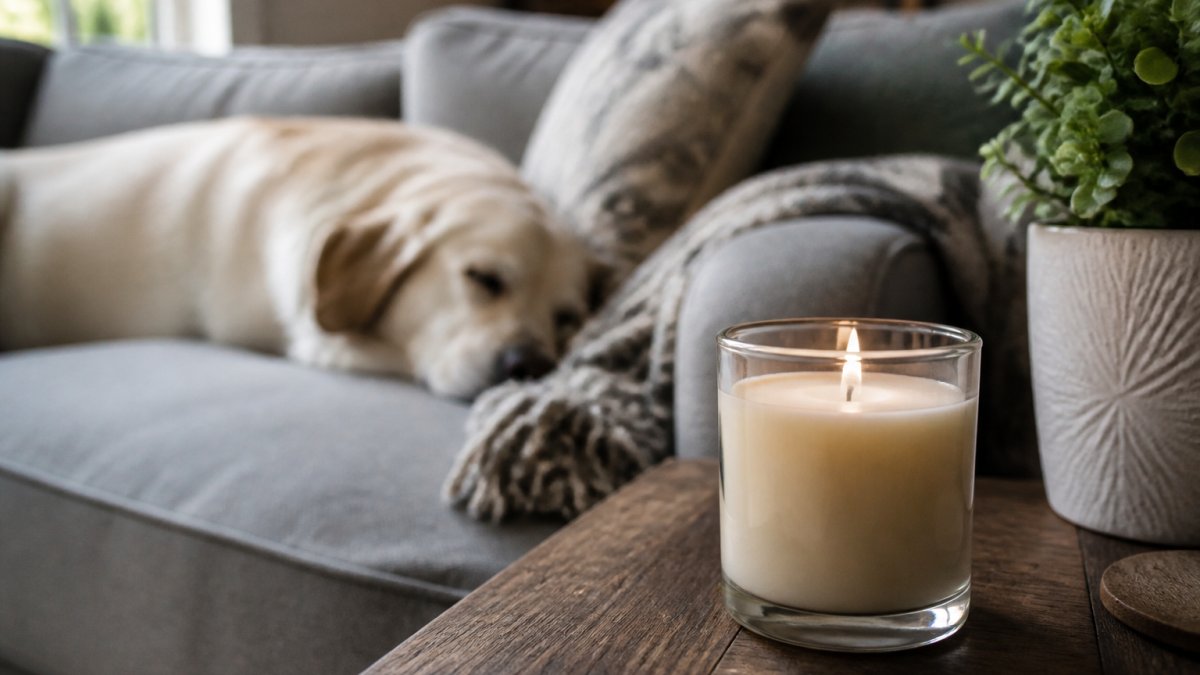
Here is the checklist we would use before buying:
Dried Oak & Lavender Pet Odor Eliminator Candle - Earthy Woodsy Scented 13oz →
- Wax: Soy blend or another clean-burning wax, not paraffin alone.
- Wick: Cotton, not metal-core.
- Fragrance: Phthalate-free and carcinogen-free.
At Belle & Mr. Our Into the Woods Pet Odor Eliminator Candle carries a 5.0 out of 5.0 rating from customers, and the 13oz jar is priced at $28.99.

| Feature | What to Look For | Why It Matters |
|---|---|---|
| Wax | Soy blend | Cleaner burn, less soot |
| Wick | Cotton | Lower smoke output |
| Fragrance | Phthalate-free | Fewer airborne irritants |
| Burn time | Stated on label | Predictable cost per hour |
| Scent | One you enjoy | You will actually use it |
How to Get Rid of Pet Odors: Candles Plus Source Removal
Candles handle the air; cleaning handles the source.
Start by locating the source. Pet odors come from four places, each needing a different approach:
- Urine in carpet or rug padding: The liquid wicks into the backing and pad, where it stays wet and keeps releasing odor. Surface cleaning does not reach it. Apply an enzymatic cleaner generously, let it dwell for the full contact time on the label (often 10 to 15 minutes), then blot and dry. In severe cases the pad has to be replaced.
- Upholstery and bedding: Wash removable covers in the hottest water the fabric allows. For non-removable cushions, use an enzymatic spray, work it into the foam with a soft brush, and air dry completely. A wet cushion will smell worse, not better.
- Litter boxes and surrounding floor: Scoop daily, fully change litter on a schedule, and wash the box with mild detergent. Urine soaked into the floor beneath the box needs the same enzymatic treatment as carpet.
Once the source is treated, compare your odor-control options honestly:
| Method | Speed | Effectiveness on persistent odor | Relative cost | Best use case |
|---|---|---|---|---|
| Source removal (enzymatic cleaner, washing) | Slow, hours to days | High, if the source is reachable | Low to moderate | Any odor embedded in a surface |
| Ventilation (open windows, exhaust fan) | Fast, minutes | Moderate, temporary | Free | Clearing the air after cleaning |
| Air purifier with carbon filter | Moderate, minutes to hours | Moderate to high for airborne odor | High upfront, ongoing filter cost | Continuous background control in a closed room |
| Odor-neutralizing candle | Fast, minutes | Low to moderate, temporary | Low per use | Finishing touch after the source is treated |
| Spray air freshener | Fast, seconds | Low, mostly masking | Very low | Quick cover-up, not a solution |
| Absorbers (activated charcoal, baking soda) | Slow, hours to days | Low to moderate | Low | Small enclosed spaces like closets or cars |
The pattern is consistent: methods that remove or destroy the odor source work best and take the longest, while the fastest methods do the least. A candle sits at the fast, low-effectiveness end of that spectrum.
A practical routine looks like this:
- Treat the source with an enzymatic cleaner and let it dry fully.
- Ventilate the room for 15 to 30 minutes to flush airborne odor.
- Run an air purifier if you have one, especially in a closed bedroom or basement.
- Light the candle last, for 1 to 2 hours, to finish the room.
This order matters. A candle burned over an untreated source is fighting a losing battle, and the fragrance just sits on top of the smell.
Our Dried Oak & Lavender Pet Odor Eliminator Candle is a good fit for living rooms and bedrooms, while the Kitchen Lemon Pet Odor Eliminator Candle works well in kitchens and laundry rooms where odors tend to linger.
How Long Do Odor-Eliminating Candles Last?
Odor-eliminating candles typically last 40 to 70 hours, depending on jar size, wick care, and session length. A 13oz soy blend candle in our range burns for approximately 70 hours with proper care.
To get the most from each jar:
- Trim the wick to ¼ inch before every burn.
- Keep the wax pool free of debris.
- Stop burning when ½ inch of wax remains.
- Never move a candle while the wax is liquid.
If you burn a candle daily for a few hours, expect a 13oz jar to last several weeks. That makes cost per hour the number worth comparing, not the sticker price alone.
Verdict: Where Odor Neutralizing Candles Win and Where They Don't
Odor neutralizing candles win on maintenance and lose on rescue. They keep an already-clean home smelling fresh, but are a poor substitute for cleaning up a persistent odor source.
Here is how we would call it:
- Win: Everyday freshness in living rooms, bedrooms, and bathrooms.
- Win: Reducing mild airborne pet odors after a room has been cleaned.
- Win: Adding a scent you enjoy without harsh synthetic chemicals.
- Lose: Neutralizing a strong odor from an untreated carpet or litter box.
The claims behind odor-neutralizing candles are reasonable, but limited. Buy one expecting a fresher room, not a fix for a smell you have not cleaned up.
Persistent pet odors are frustrating, and masking them with another strong scent rarely solves anything. At Belle & Mr.
Frequently Asked Questions
Do odor-eliminating candles remove odors or just mask them?
It depends on the formula. Ordinary scented candles mostly mask smells by adding fragrance on top of the odor. Odor neutralizing candles are made with ingredients intended to interact with odor molecules in the air so they stop registering as a smell. That said, no candle removes the source of a persistent odor. For pet smells, pair a neutralizing candle with cleaning the source, such as washing bedding or treating carpets, for results that last.
Are odor-neutralizing candles safe to use around pets?
Safety depends on the wax, wick, and fragrance. Soy blend waxes and cotton wicks burn cleaner than paraffin, and phthalate-free, carcinogen-free formulas reduce the risk of irritating a pet's respiratory system. Always keep a burning candle out of reach, never leave it unattended, and ventilate the room. If your pet has asthma or other breathing issues, ask your veterinarian before regular use.
How long does an odor-eliminating candle take to work?
Most candles begin to change a room's smell within 15 to 30 minutes of lighting, once the wax pool melts and fragrance disperses. Full neutralization of a strong pet odor can take longer, especially in small rooms with poor air circulation. Running a fan or opening a window helps the scent and odor-fighting compounds spread. For heavy odors, expect to burn the candle for an hour or more.
Do scented candles actually help with pet odors?
They help most as a finishing step, not a fix. Pet odor eliminator candles can reduce how strong a room smells, and a neutralizing formula does more than a basic fragrance candle. But urine, dander, and oils soak into carpets, upholstery, and bedding, so the odor returns if the source stays. Clean the source first, then burn a candle to keep the room smelling fresh between cleanings.
How long do odor-eliminating candles last?
A 13oz soy blend candle typically burns for many hours, and some listings state roughly 70 hours of burn time. Actual life depends on wick trimming, burn length, and room draft. Trim the wick to 1/4 inch before each use, burn no more than 4 hours at a time, and keep the candle away from drafts. Following those steps helps you get the full burn time from each jar.