
Last Updated: November 2, 2026
Quick Summary
Most pet odor fades within a few days to a few weeks after thorough cleaning, depending on how deep the urine soaked in. A fresh spot on a hard floor can clear in a day, while an old stain that reached the carpet pad can take months. Drying time matters as much as the cleaning itself.
- Fresh surface spots on hard floors are usually odor-free within 1 to 3 days.
- Carpet and pad stains older than a few days can take 3 to 8 weeks to clear.
- Blot first and never rub, because rubbing pushes urine deeper into the material.
- Keep enzymatic cleaners damp during dwell time, and never wipe them off early.
- If odor persists after two full cycles, consider professional cleaning or replacing the padding.
Table of Contents
- How Long Pet Odor Takes to Fade After Cleaning, by Method and Severity
- Why Drying Time and Odor Removal Time Are Not the Same
- How to Get Dog Urine Smell Out of a Couch, Step by Step
- How Long Enzyme Cleaner Takes to Work on Pet Odor
- Why Dog Urine Smell Comes Back After Cleaning
- Post-Cleaning Troubleshooting Checklist for Lingering Odor
- Choosing a Pet Odor Neutralizer for Upholstery and Your Next Steps
- Frequently Asked Questions
How Long Pet Odor Takes to Fade After Cleaning, by Method and Severity
Most pet odor fades within a few days to a few weeks after a thorough cleaning. The exact timeline depends on how deep the urine soaked in and which method you used. A fresh accident on a hard floor can clear in a day. An old stain that reached the carpet pad can take months, and sometimes it never fully leaves without replacement.
Here is a rough guide by severity and method:
- Surface spot, fresh (under 24 hours), blotted and enzyme-treated: Odor is usually gone in 1 to 3 days as the area dries.
- Surface spot, several days old, enzyme-treated: Expect 1 to 2 weeks, often with one repeat treatment.
- Deep contamination, carpet and pad, older stain: Plan on 3 to 8 weeks, and sometimes longer, because urine reaches the subfloor.
- Upholstery with urine in the cushion core: Odor can linger for several weeks even after surface cleaning.
These are estimates, not promises. Odor fades as the compounds break down and the area dries out completely. Wet material keeps odor active, so drying time matters as much as the cleaning itself.
Why Drying Time and Odor Removal Time Are Not the Same
A common mistake is assuming that a dry surface means the smell is gone. Drying and odor removal are two separate steps.
Drying can take a few hours for a small spot on a hard floor. A cushion or carpet pad can stay damp for a day or more. Deep-seated stains often require more patience than surface treatments, which is why professional odor removal is frequently the most reliable way to ensure that lingering moisture does not lead to recurring issues.
So a spot can look dry and still smell. That does not mean the cleaning failed. It usually means the odor source is still there, deeper in the material, or the enzyme has not finished working.
How to Get Dog Urine Smell Out of a Couch, Step by Step
Here is a practical method for upholstery:
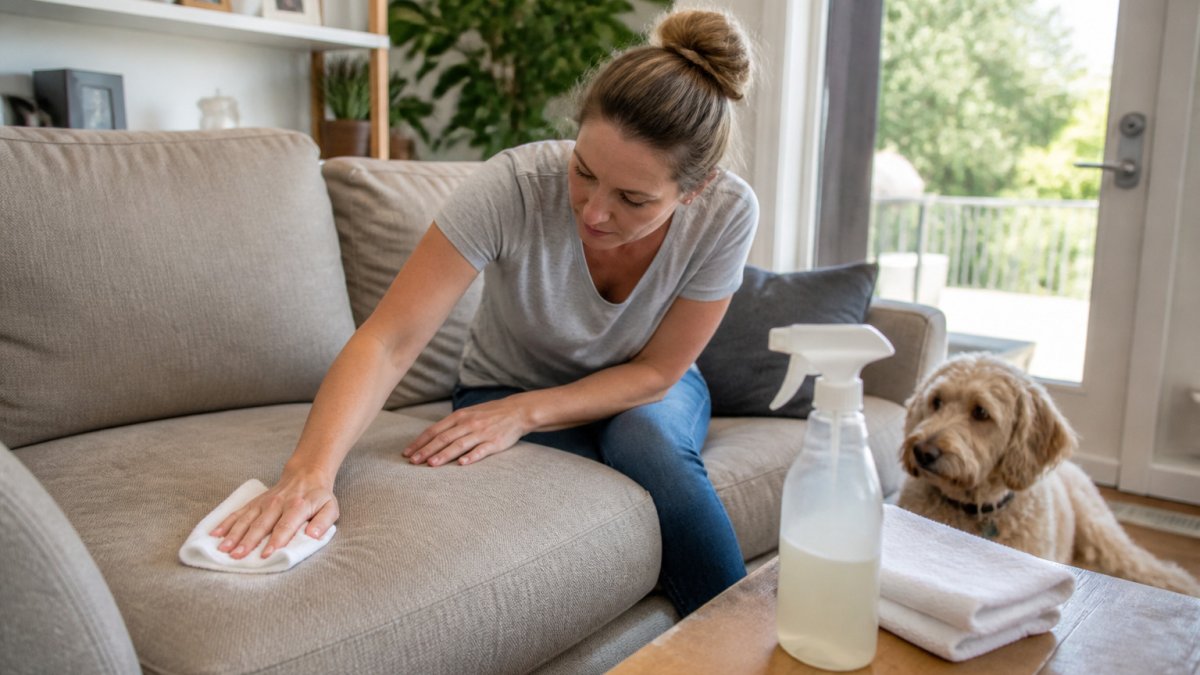
- Blot first. Press a clean white towel firmly onto the stain to pull up as much liquid as you can. Do not rub, because rubbing pushes urine deeper.
- Test the fabric. Dab an enzymatic cleaner on a hidden spot and wait for it to dry. Check for color change.
- Apply the enzymatic cleaner. Saturate the area enough to reach the cushion core, following the label directions.
- Let it dwell. Leave the cleaner on for the time listed on the label. Do not wipe it off early.
- Blot again. Remove the excess liquid with fresh towels.
- Air dry completely. Open windows, run a fan, and keep the couch dry until it feels cool and dry all the way through.
- Repeat if needed. If you still smell it once dry, repeat the process once or twice.
Watch out: Never mix enzymatic cleaners with bleach or ammonia-based cleaners. Ammonia can attract pets back to the spot, and mixed chemicals can create harmful fumes.
How Long Enzyme Cleaner Takes to Work on Pet Odor
Enzymatic cleaners work by breaking down the organic compounds in urine, urea, uric acid, and the bacteria that feed on them, rather than masking the smell. If your enzyme cleaner seems slow or ineffective, learn why enzymatic cleaners fail to remove odors and what to do differently.
Typical dwell times by product type. Most consumer enzymatic cleaners list a dwell time of 10 to 15 minutes for fresh surface spots, and 30 minutes to several hours for older or deeper stains.
Why timing varies by contamination depth.
- Surface spot on a hard floor or sealed surface: 10 to 15 minutes is often enough because the enzyme contacts the urine directly.
- Carpet surface, fresh accident: 15 to 30 minutes, then blot and air dry.
- Carpet with pad involvement: 30 minutes to a few hours, and the area should stay damp during that window. If the pad is saturated, the cleaner needs to reach it, which usually means applying enough product to penetrate rather than misting the surface.
- Upholstery cushion core: Several hours to overnight, because the foam holds liquid and the enzyme needs contact time inside the cushion.
- Subfloor or older stain: Repeated cycles of 30 minutes to a few hours, with full drying between cycles, because a single application rarely reaches the source.
Keep the area damp during dwell. Enzymes need moisture to function. If the product dries out before the dwell time is up, the reaction stalls.
Do not wipe early. Wiping off the cleaner before the label dwell time removes the enzymes before they have finished breaking down the compounds.
Product-selection trade-offs.
- Ready-to-use sprays are convenient for small spots but may not deliver enough product to reach padding; you often need to apply more than the label's minimum.
- Concentrates let you mix a stronger solution for deep contamination, but mixing errors can reduce effectiveness or damage fibers, follow the dilution ratio exactly.
- Powders and granules are useful for carpets because they stay in place and can be vacuumed up after the dwell, but they may not penetrate as deeply as liquids.
- Enzyme-free neutralizers may reduce surface odor but do not break down uric acid, so odor can return when humidity rises.
When to repeat. If you see no improvement after one full cycle of apply, dwell, blot, and dry, the enzyme likely did not reach the source. Repeat with more product and a longer dwell time rather than switching products immediately.
Dried Oak & Lavender Pet Odor Eliminator Candle - Earthy Woodsy Scented 13oz →
The table below summarises how dwell time changes with how deep the urine went.
| Contamination | Typical dwell time | Note |
|---|---|---|
| Surface spot on hard floor or sealed surface | 10 to 15 minutes | Enzyme contacts urine directly |
| Carpet surface, fresh accident | 15 to 30 minutes | Blot and air dry afterward |
| Carpet with pad involvement | 30 minutes to a few hours | Keep the area damp during dwell |
| Upholstery cushion core | Several hours to overnight | Foam holds liquid and needs contact time |
| Subfloor or older stain | Repeated 30 minute to few hour cycles | Dry fully between cycles |
Why Dog Urine Smell Comes Back After Cleaning
Odor often returns for a few predictable reasons:
- Residue stayed deep in the material. Surface cleaning did not reach the cushion core, carpet pad, or subfloor.
- The area stayed damp. Moisture reactivates the smell as it sits.
- The enzyme was not given enough time. Wiping too early leaves the source untouched.
- The spot was not fully dry. A damp core can smell stronger as it warms up.
- Old urine seeped into the subfloor. This is common on older stains and hard to reach from above.
When odor keeps coming back, the source is almost always still present. Repeating the treatment or looking deeper is usually the answer.
Post-Cleaning Troubleshooting Checklist for Lingering Odor
Use this sequence in order. Each step rules out a common cause before you spend money on another product or call a professional.
Step 2: Rule out a second accident. Pets often return to the same spot.
Step 3: Test for residue below the surface. Press a clean white towel firmly onto the spot and sniff it.
Step 5: Check for incompatible cleaning methods. If you used bleach, ammonia, or a high-pH cleaner before or after the enzyme, the enzyme may have been deactivated.
Step 6: Repeat the full cycle once. Apply, dwell for the label time, blot, and dry completely. Do not judge the result until the area is fully dry again.
Step 7: Decide whether to escalate. Use these criteria:
- Repeat treatment again if the odor is fading but still present after two full cycles, and the affected area is small (a spot or two).
- Call a professional if the odor persists after two full cycles, the affected area is larger than a dinner plate, the urine reached the subfloor, or the smell returns every time humidity rises.
- Consider replacing padding or material if the contamination is old, repeated, or the padding is crumbly or delaminated. Padding is often cheaper to replace than to clean repeatedly, and subfloor contamination may require sealing after cleaning.
Locating odor below the visible surface. Urine can travel through carpet backing into padding, then into the subfloor or tack strip.
If the smell is still strong after two full cycles and you have confirmed the source is below the surface, professional remediation or material replacement is usually the more cost-effective path than another round of consumer products.
Choosing a Pet Odor Neutralizer for Upholstery and Your Next Steps
Enzymatic cleaners work on the source of the odor. A neutralizer or candle can help freshen the room afterward, but it does not remove urine from the material. Our hand-poured soy candles are designed to help neutralize pet odors in the air, and they pair well with a proper cleaning routine. If you are wondering whether candles help at all, see our take on whether soy candles actually help with pet odors.
Start with the fresh spot first, then work through older stains. If you are weighing which neutralizer to buy for upholstery, an independent buying review compares the options side by side before you decide. Give each treatment time to dry before you judge the result. If the smell persists after two full cycles, consider a professional deep clean or replacing the padding.
Frequently Asked Questions
How long should pet odor last after cleaning?
Fresh pet odor should fade within a few days to about two weeks after a thorough cleaning with an enzymatic cleaner, depending on how deep the urine soaked and how much air circulation the room gets. Older contamination that reached the carpet padding, subfloor, or upholstery foam can take longer, and in some cases it may not disappear completely without replacing the affected material. If the smell is still strong after three to four weeks of proper treatment, the urine likely reached a layer the cleaning did not fully reach, and a deeper treatment or professional remediation is the next step.
Why does my couch still smell like dog after cleaning?
Upholstery and cushion foam absorb urine deeply, and surface cleaning removes only the part you can see or smell on top. If the cleaner did not penetrate to the foam or the backing, the odor-causing compounds remain and release slowly as the fabric warms or gets damp. Humidity can also bring the smell back. Testing with a flashlight at a low angle and treating the area again with a properly applied enzymatic cleaner usually helps, provided the cushion is not saturated through to the frame.
Do enzyme cleaners remove pet odors permanently?
Enzymatic cleaners break down the proteins and compounds in urine that cause the smell, which is why they work better than masking sprays. They can remove odor permanently when the cleaner reaches all of the contaminated material and is left to work for the full dwell time on the label. Odor often returns when the product only reached the surface, when the area was not fully dried, or when the urine soaked into a layer the cleaner never touched.
How long should an enzyme cleaner sit on pet urine?
Follow the dwell time printed on your product label, which commonly ranges from about 10 minutes to several hours depending on the formula. Keep the area damp for the full period, since the enzymes need moisture to work. Covering the spot with plastic wrap can help it stay wet on fabric. Rushing this step is one of the most common reasons the odor persists after cleaning.
