
Table of Contents
- Candle Crest vs Tildy Candle Co: What Sets Them Apart
- Candle Crest vs Tildy Candle Co Candle Scents
- Candle Burn Time Comparison: How Long Do They Last?
- Tildy Candle Co Candle Care and FAQ
- How to Compare Candle Brands Before You Buy
- Wick, Wax, and Vessel Specifications That Affect Burn Quality
- Conclusion: Which Candle Brand Fits Your Home?
- Frequently Asked Questions
Last Updated: October 14, 2026
Candle Crest vs Tildy Candle Co: What Sets Them Apart
Candle Crest vs Tildy Candle Co is a comparison shoppers keep making, and the honest answer is that these two brands sit in different corners of the home fragrance market.
That distinction matters more than most buyers expect. According to the American Cleaning Institute's guidance on indoor air and odor control, how you handle a smell at the source changes the outcome far more than the fragrance you layer on top.
Below, we break down scents, burn time, wax and wick specs, and how to compare any two candle brands before you spend money.
Candle Crest vs Tildy Candle Co Candle Scents
Scent is where these two brands diverge fastest. Other brands tend to run a tighter, more consistent core line: clean, everyday profiles like linen, cedar, and light citrus. Other brands rotate more aggressively through seasonal scents, so their catalog shifts with the calendar.
If you want a signature scent you can reorder for years, a stable core line wins. If you like variety and gift-giving, a rotating catalog is more fun. Neither approach is wrong, but they suit different buyers.
A few things to check before you commit to a scent:
- Scent profile language: "Masculine scent" and "fresh" mean different things to different brands. Look for specific notes, not mood words.
- Fragrance oil disclosure: Brands that name phthalate-free and paraben-free formulations are telling you something useful. Ask if it isn't stated.
- Strength expectations: A scent that reads bold in a small bathroom can disappear in an open living room.
Candle Burn Time Comparison: How Long Do They Last?
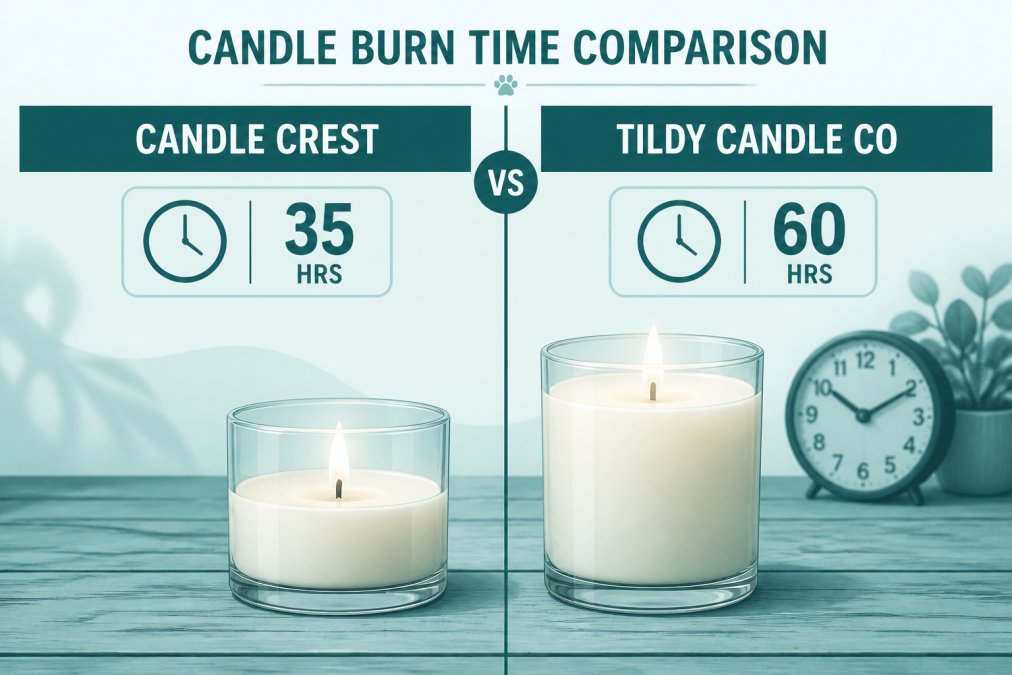
Burn time is the spec buyers compare most and understand least. A candle's burn time depends on wax composition, wick type, vessel diameter, and how you actually burn it, not just the number on the label. Most top-ranking pages stop at that sentence. Here is how to actually run the comparison.
The burn-time math most comparison posts skip
Stated burn time is a manufacturer estimate, usually measured under ideal conditions: trimmed wick, no drafts, four-hour sessions, full melt pool each time. Real-world burn time runs shorter.
That gap is why cost per burn hour is a better comparison metric than sticker price. The formula is simple:
Cost per burn hour = candle price ÷ realistic burn hours
If you only have the stated burn time, discount it by roughly 20 to 25 percent to get a realistic figure. Then divide. A candle that costs more up front but burns twice as long can be the cheaper candle per hour of use.
What actually changes burn time
| What to Compare | Why It Matters | What to Look For |
|---|---|---|
| Wick count | Affects melt pool and tunneling | Double wick for vessels wider than about 3 inches |
| Wax composition | Drives burn quality and soot | Soy blend, paraffin-free |
| Vessel diameter | Wide jars need more heat | Match wick count to width |
| Fragrance load | Higher load can clog wicks | Moderate, even scent throw |
| Stated burn time | A rough guide, not a promise | Treat as a range, then discount it |
A wider vessel with a single wick will tunnel and waste wax. A double wick spreads the melt pool evenly and usually burns cleaner and longer per ounce. When you compare burn times, don't compare the sticker. Compare the wick count, the vessel diameter, and the wax blend, then run the cost-per-hour math on comparable sizes.
How to test scent throw fairly
Burn time and scent throw are related, and both are usually reported without method. To compare two candles fairly, control the variables:
- Room size: Test in a closed room of a known size, not an open floor plan. A small bedroom and an open living room will give opposite verdicts on the same candle.
- Burn duration: Evaluate throw at the one-hour mark and again at the three-hour mark. Many candles peak early and fade.
- Distance: Note how far you are from the candle when you can first smell it. Two feet and ten feet are different claims.
- Cold vs. hot throw: Cold throw is what you smell unlit in the jar. Hot throw is what fills the room while burning. They are not the same, and brands rarely separate them.
A candle care habit changes burn time more than brand choice. Trim the wick to about a quarter inch before every burn, and let the first burn reach a full melt pool. Skip that, and even a well-made candle burns unevenly and loses hours off its rated life.
Tildy Candle Co Candle Care and FAQ
Candle care is the cheapest upgrade you can make, and it applies to every brand equally. Soy-blend candles, like any, perform best with a little routine.
Why does my candle smell weaker after a few burns? Wick trimming and melt pool matter here. A mushroomed wick burns cool and throws less scent.
How long should I burn a candle at once? Four hours is a reasonable ceiling.
How to Compare Candle Brands Before You Buy
Comparing candle brands comes down to five checks, and none of them require trusting a marketing page.
- Read the wax composition. "Natural wax" and "soy wax" are not the same claim. Ask which.
- Confirm the wick type. Cotton wick and double wick setups generally burn cleaner than mystery blends.
- Check the ingredient list for phthalate-free and paraben-free language. If it's absent, ask.
- Match candle size to room size. A 16-ounce candle in a tiny bathroom is overkill; a small candle in an open floor plan won't throw.
- Look at the vessel. Thick glass holds heat and burns more evenly than thin decorative jars.
Don't buy a candle based on a single five-star review. Scent throw is subjective and room-dependent. Look for reviews that mention the room size and the burn habits, not just "smells amazing."
Wick, Wax, and Vessel Specifications That Affect Burn Quality
Wick performance, wax composition, and vessel design decide whether a candle burns clean or turns into a smoky mess. These three specs matter more than the scent name on the front, and they are the specs most comparison posts leave vague. Here is what to actually check.
Wax composition
Wax sets the baseline. Soy wax and soy-blend waxes tend to burn cooler and produce less soot than straight paraffin. A paraffin-free claim is worth checking, because it usually signals a cleaner burn and less black residue on the jar. But "natural wax" and "soy wax" are not the same claim. Natural wax can mean a coconut, palm, or beeswax blend, and each behaves differently. Ask which waxes are in the blend, not just whether it is "natural."
Wick specifications
Wick performance controls the flame, and wick count is the spec buyers overlook most. A cotton wick sized correctly for the vessel gives an even burn. An oversized wick in a wide jar tunnels; an undersized one drowns. As a rough guide, vessels wider than about 3 inches generally need two wicks to reach a full melt pool, while narrower vessels can run a single wick. Wick material also matters: cotton and cotton-paper wicks are the common clean-burning options, while some wood wicks crackle but can be harder to keep lit in humid rooms.
Vessel specifications
Vessel capacity, glass thickness, rim height, and diameter all change how the melt pool forms. A well-matched wick and vessel is the difference between a candle that lasts and one that wastes half its wax. When comparing two candles, line up the vessel capacity in ounces, the wick count, and the stated burn time side by side. If one brand lists a 16-ounce vessel with two wicks and the other lists a 16-ounce vessel with one, they will not burn the same way, and the burn-time numbers are not directly comparable.
How to verify ingredient and safety claims
Terms like non-toxic, phthalate-free, clean-burning, and paraben-free get used loosely. Here is how to separate a disclosed ingredient list from a marketing claim:
- Phthalate-free: Phthalates are a class of chemicals sometimes used in fragrance oils. A brand that states phthalate-free is making a specific, checkable claim. Ask whether it applies to every scent or only some.
- Paraben-free: Parabens are preservatives more common in cosmetics than candles. The claim is easy to make and rarely relevant to candle performance, so treat it as a minor signal.
- Non-toxic: This is not a regulated term for candles. Ask what the brand means by it, and whether they can point to a specific ingredient list.
- Clean-burning: Usually refers to low soot, which is driven by wax type and wick sizing, not by a certification. A paraffin-free wax with a correctly sized cotton wick is the practical version of this claim.
Ask the brand for the full fragrance and wax ingredient list, not just the marketing summary. Brands that disclose specifics will answer directly. Brands that don't will describe their "proprietary blend."
For pet owners specifically, this is where the choice gets practical. Belle & Mr. Tom builds its candles on a soy-blend base with odor neutralizers rather than relying on fragrance alone, which is the difference between a candle that covers a smell and one that removes it. Our Into the Woods Pet Odor Eliminator Candle holds a 5.0 out of 5.0 customer rating.
Conclusion: Which Candle Brand Fits Your Home?
Other brands may suit buyers who want a stable, minimal core line, or those who want seasonal variety and gift-ready scents. The right pick depends on your room size, your scent preferences, and whether you need the candle to do more than smell pleasant.
If you're a pet owner fighting persistent odor, that last point is the whole game. A candle that masks a smell for an hour isn't solving your problem. Belle & Mr.
Frequently Asked Questions
What is the difference between Candle Crest and Tildy Candle Co?
The main differences come down to wax composition, wick type, and scent variety. Candle Crest tends to focus on classic seasonal scents with cotton wicks, while Tildy Candle Co offers a broader range of fragrance profiles and vessel styles. Burn time and scent throw vary by candle size, so check the specific product specs before choosing. Both brands use soy-based wax blends, but ingredient lists and additives can differ. Comparing wax type, wick material, and burn time side by side is the fastest way to see which fits your needs.
How long do candles from Candle Crest and Tildy Candle Co burn?
Burn time depends on candle size, wax type, and wick performance. A 16-ounce soy candle typically burns for 60 to 80 hours under ideal conditions, which means trimming the wick to 1/4 inch before each use and burning for 2 to 4 hours at a time. Smaller candles in the 8-ounce range usually last 30 to 40 hours. Check each brand's product page for specific burn time estimates, and keep in mind that drafty rooms or neglected wicks can shorten burn time significantly.
Does Tildy Candle Co offer candle care instructions?
Tildy Candle Co provides candle care guidance on its product pages and packaging, covering wick trimming, recommended burn durations, and proper extinguishing. Standard candle care applies to both brands: trim the wick to 1/4 inch before every burn, keep the candle away from drafts, and stop burning when 1/2 inch of wax remains. Following these steps helps prevent tunneling, soot, and uneven burns. If you are unsure about a specific candle, check the brand's website or insert card for detailed instructions.
How can I tell whether a candle is a good value?
Value is not just about the sticker price. Divide the cost by the estimated burn hours to get a cost-per-hour figure. A candle that costs more upfront but burns 70 hours may be cheaper per hour than a budget option that burns 25 hours. Also factor in scent throw, wax type, and whether the candle burns evenly or tunnels. Soy wax candles tend to burn longer and cleaner than paraffin, which can offset a higher upfront cost. Reading reviews and checking burn time specs helps you compare accurately.