
Table of Contents
- What Nose Blindness Means for Pet Owners
- How to Tell If Your House Smells Like Pets
- How to Reverse Nose Blindness: A Step-by-Step Reset
- Nose Blind to Cat Pee: Why Cat Odor Hides Best
- How to Get Rid of Pet Odor in the House
- Pet-Safe Products and Fragrance Risks
- A Realistic Cleaning Schedule by Odor Source
- Conclusion
- Frequently Asked Questions
Last Updated: October 18, 2026
What Nose Blindness Means for Pet Owners
Nose blindness is the brain's habit of tuning out smells it encounters constantly, which is why you may stop noticing pet odor in your own home while guests notice it right away.

This is normal. The same olfactory adaptation process described by the NIH keeps you from smelling your own shampoo by noon.
The trouble is what happens next: you clean less, odor builds, guests say nothing, and the gap grows.
How to Tell If Your House Smells Like Pets
The only reliable test is a nose that hasn't adapted to your home. These checks work, ranked by reliability.
The Guest Test and Other Honest Checks
- The guest test: Ask someone who hasn't visited in a month. Their nose is calibrated to normal, not to your house.
- The doorway test: Step outside for ten minutes, then walk back in. The first breath tells you more than an hour of sniffing.
- The fabric sniff: Press your nose into a couch cushion or pet bed and inhale. Upholstery holds odor long after the air clears.
How to Reverse Nose Blindness: A Step-by-Step Reset
You reverse nose blindness by giving your nose a full reset, then re-entering the house with a fresh reference point. It takes about a day and costs nothing.
Step 1: Leave the House for a Full Day
Spend at least six to eight hours away, a real break, not a quick errand. When you return, pause in the entryway before doing anything else. That first breath is your honest reading.
Step 2: Reset Your Scent Reference Point
Your nose compares everything to your last smell. Use that.
- Smell coffee beans or a fresh lemon before you walk back in.
- Walk room by room, starting with the room you use least.
- Note which rooms hit you first, those are your problem areas.
Repeat monthly; nose blindness returns because your brain keeps adapting.
Nose Blind to Cat Pee: Why Cat Odor Hides Best
Cat urine is the hardest pet odor to notice, which is why so many cat owners are nose blind to it specifically.
Cat urine contains urea, which breaks down into ammonia, plus uric acid and pheromone-bearing proteins. The ammonia is what you smell first, sharp right after an accident.
Regular cleaners don't dissolve uric acid crystals; enzyme cleaners do, breaking the crystal structure down so it can be rinsed away.
Signs Your Nose Is Missing Cat Odor
- Your cat avoids a corner of the room, a specific closet, or the area around a particular piece of furniture.
- Guests sneeze, wrinkle their nose, or comment on a "basement smell" near the litter box area.
- The litter box sits in a carpeted, enclosed, or poorly ventilated space.
How to Find Hidden Cat Urine
Your nose adapts within minutes of entering a room, so don't rely on it. Use a UV flashlight after dark with the lights off: urine deposits, even old, dried ones, fluoresce yellow-green. Mark each spot with painter's tape, then treat in order of size. For carpet, saturate with an enzyme cleaner, cover with a damp towel, let it sit for the full dwell time on the label (often 10-30 minutes), then blot and air-dry.
When Cat Odor Signals a Health Problem
A persistent smell that survives thorough cleaning is a veterinary question, not a cleaning question. A cat with dental disease, ear infection, anal gland impaction, or kidney issues can produce odor no carpet cleaning will fix. Sudden litter-habit changes, urinating outside the box, straining, or avoiding the box, can signal a urinary tract problem and warrant a vet visit. If the smell comes from the cat rather than the room, start with the vet.
How to Get Rid of Pet Odor in the House
Getting rid of pet odor means removing the source, not covering the air. Air fresheners and sprays mask the smell for an hour. The odor returns because the source never left.
Clean the Source, Not the Air
Start by finding where the smell actually lives. Walk the house with your nose and a flashlight. Check baseboards, corners, under furniture, and the floor around the litter box.
Then clean in this order:
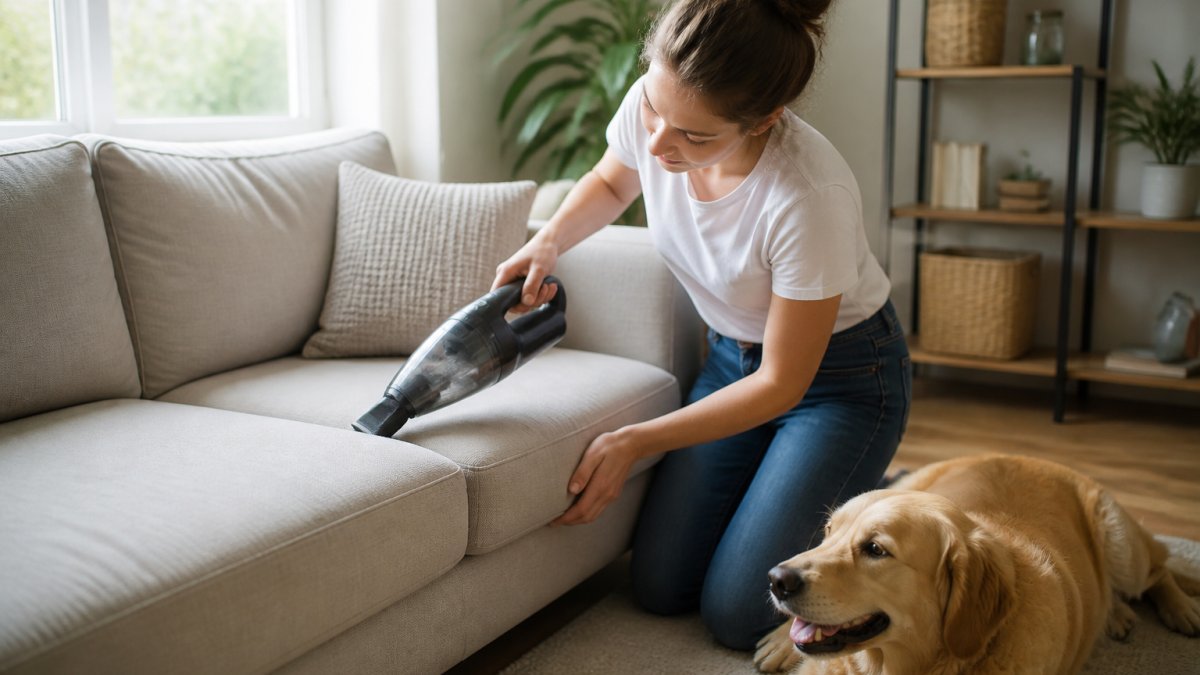
- Remove solids and vacuum loose hair and dirt.
- Wash hard surfaces with an unscented pet-safe cleaner.
- Treat soft surfaces with an enzyme cleaner made for pet waste.
- Let everything dry fully with windows open.
Skip the scented disinfectant. It adds chemical odor on top of pet odor, and the mix is worse than either alone.
Fabrics, Bedding, and Carpets
Soft materials hold most household pet odor. Tackle them on a schedule, not just when you notice a smell.
- Pet bedding: wash weekly in hot water.
- Couch cushions and throws: wash or vacuum every two weeks.
- Carpets and rugs: vacuum twice a week, deep clean every few months.
Brushing your pet outdoors removes loose hair before it lands on fabric. Regular grooming cuts the oil and dander that feed odor buildup.
EPA guidance on indoor air quality and ventilation is worth reading if odors keep returning after cleaning. Better airflow does a lot of quiet work.
Pet-Safe Products and Fragrance Risks
Pet-safe cleaning means unscented or naturally scented products with no phthalates, and it matters more than most owners realize.
A common mistake is reaching for the strongest-smelling cleaner on the shelf. Strong scent is not clean. It's just a different smell layered over the problem.
Dried Oak & Lavender Pet Odor Eliminator Candle - Earthy Woodsy Scented 13oz →
What we look for:
- Unscented or lightly scented cleaners
- Phthalate-free formulas
- No aerosol sprays around birds or small pets
For ongoing freshness, the ASPCA's guidance on household toxins is a solid reference on what to keep away from pets.
When we want the room to actually smell good, we use our own pet odor eliminator candles. Our Dried Oak & Lavender candle is the one we reach for in living rooms, and the Into the Woods candle works well in bedrooms and home offices.

A Realistic Cleaning Schedule by Odor Source
Matching your cleaning frequency to the actual odor source beats a vague "clean more often" plan. Use the inspection checklist first, then apply the schedule to what you find.
Room-by-Room Pet Odor Inspection Checklist
Walk the house with a flashlight and a notepad. Check each item and mark it clean, suspect, or confirmed.
Entry and living room
- Baseboards and corners where pets rub or mark
- Couch cushions, seams, and under-cushion decking
- Area rugs and the pad beneath them
Bedrooms
- Pet beds and blankets
- Under the bed and behind the headboard
- Closet floors and stored linens
Kitchen and laundry
- Trash can exterior and floor around it
- Pet food and water bowl mats
- Laundry hamper interior
Bathrooms
- Litter box area, including the wall behind it
- Grout lines and base of the toilet
- Bath mats and towels
Pet-specific zones
- Crate interior and the floor beneath it
- Litter mat and the floor under the box
- Food storage bin lid and surrounding shelf
- Grooming tools and brushes
Objective Assessment: How to Get an Honest Reading
Your nose adapts within minutes, so build in a repeatable check.
- The re-entry test: Leave the house for at least 30 minutes, then walk in and pause in the entryway. Note the first smell.
- The trusted visitor: Ask someone who hasn't been in your home for at least a month to describe what they smell, not whether it smells, but what it smells like.
- The fabric press: Press your nose into a couch cushion, pet bed, and carpet edge and inhale. Upholstery and padding hold odor long after the air clears.
- The closet check: Open a coat closet or linen cabinet. Enclosed spaces with low airflow collect odor.
Write down what you find each time; comparing notes month to month beats trusting an adapted nose.
Odor Removal vs. Scent Masking
These are not the same job, and confusing them is why odor returns.
| Approach | What it does | Best for | Limitation |
|---|---|---|---|
| Scent masking (candles, sprays, plug-ins) | Adds a stronger fragrance over the existing smell | Brief freshness between cleanings | Does not remove the source; odor returns when the fragrance fades |
| Air purification (HEPA + carbon) | Traps particles and adsorbs some volatile compounds | Ongoing background odor, dander, litter dust | Does not reach odor bound in fabric or subfloor |
| Enzyme cleaning | Breaks down uric acid crystals and proteins at the source | Urine, vomit, feces on soft and hard surfaces | Requires dwell time and full saturation |
| Deep cleaning and extraction | Removes soil, hair, and odor-holding residue | Carpets, upholstery, bedding | Needs repetition for old deposits |
| Ventilation | Dilutes and exhausts indoor air | Whole-home background odor | Temporary; source remains |
Source removal comes first. Masking and air purification are maintenance steps, not fixes.
The Schedule
| Odor Source | Task | Frequency |
|---|---|---|
| Litter box | Scoop and wipe the box | Daily |
| Litter box | Full change and wash the box | Weekly |
| Litter area | Wipe walls and floor around the box | Weekly |
| Pet bedding | Hot water wash | Weekly |
| Carpets and rugs | Vacuum | Twice weekly |
| Carpets and rugs | Deep clean or extract | Every 3-6 months |
| Upholstery | Vacuum and spot clean | Every two weeks |
| Hard floors | Wash with pet-safe cleaner | Weekly |
| Pet grooming | Brush and bathe | Every 2-4 weeks |
| HVAC filter | Replace or clean | Every 1-3 months |
| Whole home | Open windows and air out | Daily |
| Whole home | Full inspection checklist | Monthly |
Post this where you'll see it. Most odor problems aren't from laziness. They're from not having a rhythm, and from a nose that stopped reporting the problem months ago.
Conclusion
The hardest part of pet odor isn't cleaning. It's trusting a nose that stopped working months ago.
That's where we come in. Our Into the Woods Pet Odor Eliminator Candle holds a 5.0 out of 5.0 rating from customers, and every candle ships for $28.99 with subscription options.
Get started with Belle & Mr. Tom and let your home smell as clean as it actually is.
Frequently Asked Questions
How do you reverse nose blindness to pet odors?
Leave your home for several hours, then walk back in and notice what hits you at the door. That first breath is the closest you get to a guest's impression. To reverse nose blindness more permanently, rotate the scents you use, ventilate daily, and clean odor sources on a schedule instead of relying on your nose to remind you. An odor-neutralizing candle such as Into the Woods can help reset your reference point, but it works best after the source itself is cleaned.
Can you become nose blind to cat pee?
Yes, and cat urine is one of the easiest odors to adapt to because it builds up slowly in litter boxes, carpets, and upholstery. Ammonia compounds in cat pee are strong at first, but constant low-level exposure dulls your response within days. Check litter boxes daily, replace litter on schedule, and clean any accident spots with an enzymatic cleaner. If guests mention a smell you cannot detect, treat that as your signal to do a full room-by-room inspection.
How often should I clean areas where my pets sleep?
Wash pet bedding weekly in hot water, vacuum sleeping spots two to three times a week, and deep clean carpets and upholstery every one to two months. Litter boxes need scooping daily and a full litter change at least weekly. These intervals matter more than how the room smells to you, because nose blindness means your nose stops flagging buildup long before guests notice it.
Are odor-neutralizing candles effective for pet smells?
They help with lingering airborne odors, but they are not a substitute for cleaning. A candle formulated to neutralize odors, like Belle & Mr. Tom's soy blend options at $28.99, works best in a room that has already been vacuumed and aired out. Use it to keep a fresh baseline between deep cleans, and pick phthalate-free candles if you are concerned about what your pet breathes in.