

Last Updated: October 25, 2026
Quick Summary
You can tell if your house smells like pets by leaving for at least two hours, then walking back in through the front door and judging your first breath, which is what guests experience. Watch guests who pause, sniff, or open windows, and press into sofas and rugs to check soft surfaces.
- Olfactory adaptation is the brain tuning out smells it encounters constantly, so your nose stops reporting them.
- If you checked three or more signs on the checklist, treat your home as a pet-odor home.
- Work room by room starting with pet beds and blankets, which hold the most concentrated odor.
- Cleaning often falls short because the smell lives in the carpet pad, not the carpet.
- The candle test uses an unscented candle to make odor easier to notice in still air.
Table of Contents
- Why Your Nose Adjusts to Pet Odors (and Guests Still Notice)
- The 7 Signs Your House Smells Like Pets
- How to Find the Source of Pet Odor Room by Room
- Why Does My House Smell Like Dog Even After Cleaning?
- How to Remove Pet Odor From Carpet and Upholstery
- Testing Your Air Quality to Confirm the Smell Is Gone
- Neutralize What Cleaning Leaves Behind With a Pet Odor Eliminator Candle
- Frequently Asked Questions
Why Your Nose Adjusts to Pet Odors (and Guests Still Notice)
If you're wondering how to tell if your house smells like pets, the honest answer is that you probably can't, at least not reliably. Your nose is a poor judge of your own home. This guide from Belle & Mr. Tom walks through the tests that actually work.
The reason is olfactory adaptation, which is the brain's habit of tuning out smells it encounters constantly. In plain terms, your nose stops reporting a scent it decides is background noise. Guests walk in with a fresh nose, so they smell what you stopped noticing months ago.
That gap creates real embarrassment. You host a dinner, someone's face shifts, and you realize the living room has a story you can't smell.
Below, we'll show you exactly how to check your home the way a guest experiences it, plus what to do once you find the source. You can also read our guide on how to stop nose blindness to pet odors if you want to reset your sense of smell first.
The 7 Signs Your House Smells Like Pets
The seven signs your house smells like pets are: a stuffy note when you walk in after being away, odor that returns fast after cleaning, guests who react at the door, lingering smell near soft surfaces, a bathroom or laundry room that never feels fresh, visible buildup on fabric, and air that smells fine to you but not to visitors.
Here's the full checklist. Run through it room by room.
- You notice a smell only after a trip or a full day out
- The odor comes back within a day or two of cleaning
- Guests comment, sniff, or open windows
- Sofas and rugs smell stronger when you press into them
- The entryway or pet bed area has a permanent stale note
- Fabrics show dull patches or ring marks
- You've stopped trusting your own nose
If you checked three or more, treat your home as a pet-odor home and keep reading.
The Fresh-Air Return Test
The fresh-air return test is the simplest way to check your home: leave for at least two hours, then walk back in and judge the first breath. That first breath is what your guests experience.
Do it right:
- Step outside for two hours or more
- Avoid wearing strong perfume or cologne
- Enter through your front door, not the garage
- Pause in each room and breathe normally
If the entryway hits you with a stale note, that's your answer. Note which room smells strongest and how quickly the smell fades.
The Guest Reaction Check
Watch your visitors at the door. A guest who pauses, sniffs, or asks to open a window is telling you something your nose won't.
Ask one trusted friend directly. Something like, "Be honest, does this room smell like my dog?" Most people will answer if you make it easy.
Signs worth noting:
- Guests who hover near windows or doors
- Anyone who comments on the "fresh air" inside
- Friends who stop accepting dinner invites
Here are the seven signs to check, room by room.
| Sign | What to look for |
|---|---|
| Smell after time away | You notice a smell only after a trip or full day out |
| Odor returns fast | The odor comes back within a day or two of cleaning |
| Guest reactions | Guests comment, sniff, or open windows |
| Soft surfaces | Sofas and rugs smell stronger when you press into them |
| Entryway or pet bed | A permanent stale note in the area |
| Visible buildup | Fabrics show dull patches or ring marks |
| Nose blindness | You've stopped trusting your own nose |
How to Find the Source of Pet Odor Room by Room
Finding the source of pet odor means working room by room from the outside in, checking soft surfaces, corners, and anything a pet touches, then ranking rooms by smell strength. Start where your pet spends the most time.
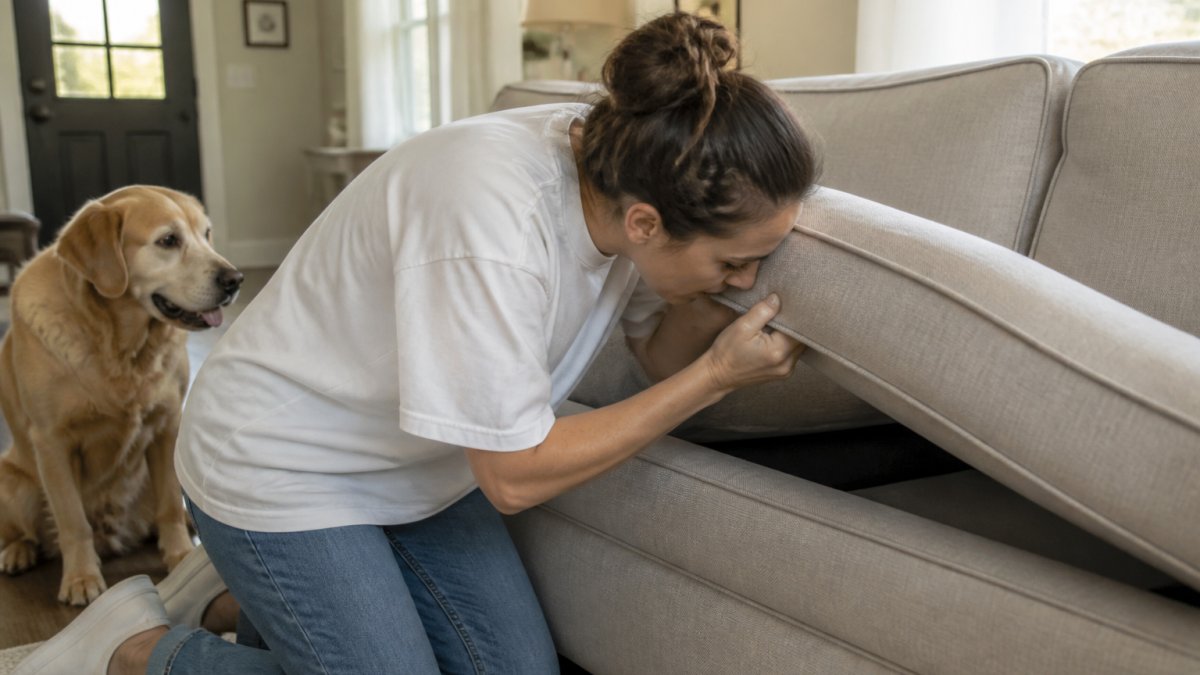
Work through the house in this order:
- Pet beds and blankets. These hold the most concentrated odor.
- Sofas and chairs. Press down on cushions and smell your hand.
- Carpets and rugs. Get low and sniff near baseboards.
- Cat litter boxes. Even covered boxes leak odor into the room.
- Laundry and bathroom areas. Damp fabric traps smell.
- Air vents and corners. Odor settles where air moves slowly.
If the litter box turns out to be the culprit, our guide on how to get rid of cat litter smell covers a targeted fix in seven steps.
Dried Oak & Lavender Pet Odor Eliminator Candle - Earthy Woodsy Scented 13oz →
Why Does My House Smell Like Dog Even After Cleaning?
Your house smells like dog after cleaning because most cleaning removes surface dirt, not the odor molecules soaked into fabric, padding, and flooring. Shampooing a rug cleans the fibers. It doesn't always reach the pad underneath, which is where pet odor settles.
A few common reasons cleaning falls short:
- The smell lives in the carpet pad, not the carpet
- Pet beds and cushions get washed less often than floors
- Airflow is poor, so odor lingers in still rooms
- Cleaning products add fragrance that fades and reveals the smell again
- The source is somewhere you haven't checked, like a baseboard or vent
This is the part most people get wrong. They clean harder instead of cleaning deeper.
How to Remove Pet Odor From Carpet and Upholstery
Removing pet odor from carpet and upholstery requires reaching the padding and cushion foam, not just the surface fibers. Use an enzyme cleaner, give it dwell time, and dry the area fully.
Here's a practical order of operations:
- Vacuum thoroughly. Slow passes, both directions.
- Blot any stains. Press, don't rub.
- Apply an enzyme cleaner. Follow the label and let it sit for the full dwell time.
- Pull up the carpet edge. Check the pad if the smell persists.
- Dry completely. Airflow and a fan, not just time.
- Wash removable covers. Pet beds and cushion covers included.
For a full walkthrough on soft surfaces, see our guide on how to remove dog smell from upholstery fast.
Testing Your Air Quality to Confirm the Smell Is Gone
Confirming the smell is gone means testing with a fresh nose, not your own. The most reliable test is a two-hour absence followed by a walk-in check at the front door.
Other ways to check:
- The candle test. Light an unscented candle in the room, wait, and blow it out. Odor becomes easier to notice in still air.
- The fabric press. Press a clean white cloth into the cushion and smell it.
- The outsider check. Ask one honest person to walk in cold.
- The closet test. Open a closet that's been shut for a day and take a breath.
If the smell returns within a day of testing, the source is still there. Go back to the room-by-room search.
Neutralize What Cleaning Leaves Behind With a Pet Odor Eliminator Candle
Cleaning removes the dirt. It doesn't always remove the odor molecules left in the air and fabric. That's where a candle formulated to neutralize odor, rather than mask it, earns its place.
At Belle & Mr. Tom, we hand-pour soy-blend candles made to neutralize pet odors instead of covering them with fragrance. Before you buy, our review on whether odor neutralizing candles really work breaks down what to expect.
Our top pick for most homes is the Dried Oak & Lavender Pet Odor Eliminator Candle. It's a 13oz soy blend candle with an earthy oak and lavender scent, and it's phthalate-free and Prop 65 compliant. It's $28.99, and it suits living rooms and bedrooms where you want calm rather than a sharp citrus note.

If your kitchen is the problem room, the Kitchen Lemon Pet Odor Eliminator Candle targets both pet and cooking odors. The Into the Woods candle brings a pine and eucalyptus note for year-round freshness.


Best for: pet owners who clean regularly but still notice a lingering smell. Skip if: you haven't found and removed the source yet. Fix the source first.
Frequently Asked Questions
How can I tell if my house smells like pets?
Step outside for 10 to 15 minutes, then walk back in and notice the first breath you take. That first impression is close to what guests experience. You can also ask a trusted friend who does not live with you for an honest answer, or check the spots pets spend the most time: bedding, sofa cushions, carpet edges, and the area around the litter box. If any of those give off a sour or musty smell up close, your house smells like pets even if you cannot detect it from the doorway.
Why does my house smell like dog even after cleaning?
Cleaning removes what you can see and reach, but pet oils and urine salts soak into soft surfaces like carpet padding, upholstery, and baseboards. A surface wipe or vacuum pass does not pull those out, so the smell returns as soon as the room warms up or humidity rises. Check under area rugs, along the base of walls, and inside pet beds. If the smell comes back within a day of cleaning, the source is below the surface and needs a deeper treatment.
How do I find where a pet smell is coming from?
Work room by room with the doors closed and sniff low, near the floor, since pet odors settle. Use a blacklight on carpet and upholstery in a dark room: dried urine shows up as a yellow-green glow. Pay attention to soft items that hold odor longest, including pet beds, throw blankets, curtains, and sofa cushions. Once you locate the room, narrow it down to the exact spot before treating anything, so you do not waste effort on surfaces that are not the source.
How do I check whether pet odors are still there after cleaning?
Wait until the room is fully dry, then close the windows and leave for 20 minutes. When you return, smell at floor level and near the treated area. Warm, humid days are the best test because heat releases trapped odor. If a faint smell remains, repeat the treatment on the source rather than covering it with fragrance. A pet odor eliminator candle made with a soy blend, like Belle & Mr. Tom's 13oz options at $28.99, can help confirm the room reads fresh to guests once the source itself is treated.
Your home can smell clean without you having to guess whether it actually does. The tests above tell you the truth, and a candle built to neutralize odor handles what cleaning leaves behind. Belle & Mr. Tom hand-pours soy-blend candles with odor neutralizers, offers phthalate-free and Prop 65 compliant formulas, and gives you a subscription option so a fresh home never runs out. Get started with Belle & Mr. Tom and give your guests a fresh breath at the door.
